
The Best Home & Office Security Systems of 2026
Essential Security Cameras
Why do you need Home Security Systems?
Home Security Systems have become crucial these days. You may be on long periods of vacation or somewhere outside, and your home may be subjected to threats such as gas leaks or even a fire outbreak. In other cases, thefts and home invasions might occur.
Security cameras can be monitored by trained agents
Wireless and battery-powered indoor and outdoor models
Cameras work with a full home security system
We could safeguard ourselves better from such incidents by installing surveillance systems.
Advanced Topologies
For applications without a direct power grid, you can implement a Passive Optical Network (PON). This design uses passive optical splitters in the field to divide the light signal from a single fiber strand across multiple cameras, entirely eliminating the need for powered electronics in remote fields. The signal is then converted into Ethernet at each camera’s Optical Network Unit (ONU) and powered by independent solar arrays. [1]
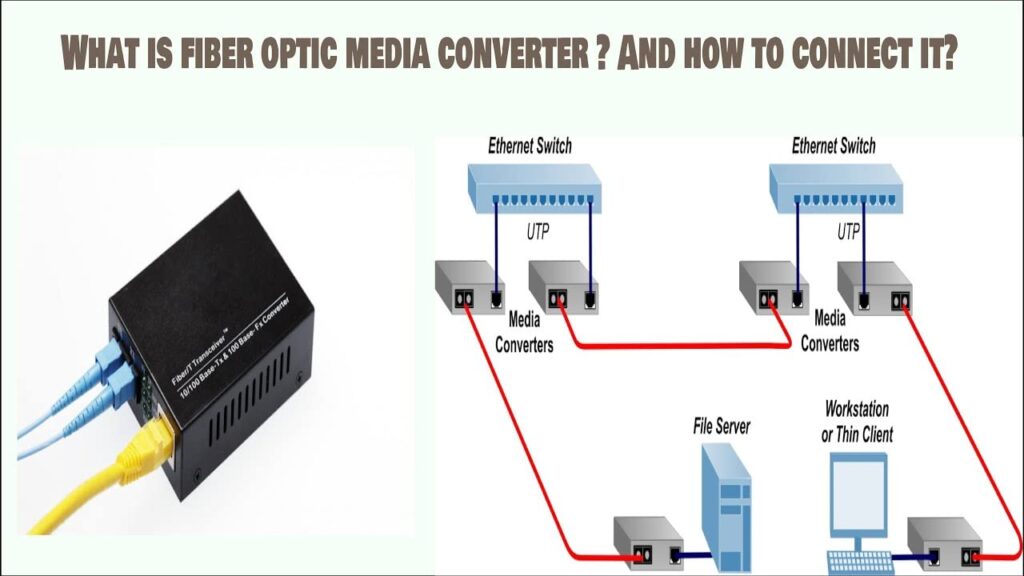
A fiber optic media converter is a networking device that bridges dissimilar media types by converting electrical signals from copper cables (like Ethernet) into light signals for fiber optic cables. This allows networks to transmit data securely over much longer distances than standard copper limits
How it Works
Typically deployed in pairs, a converter receives an electrical signal from a copper-based device (e.g., a switch or router), translates it into an optical light pulse, and sends it across a fiber strand. At the other end, a second converter reverses the process, turning the light back into an electrical signal the receiving device can understand.
Key Benefits
- Distance Extension: While copper Ethernet is usually limited to 100 meters, fiber optics can transmit data over distances spanning from 2 kilometers (multimode) to over 100 kilometers (single-mode).
- Interference Immunity: Fiber cables are entirely made of glass, making them completely immune to electromagnetic interference (EMI), radio frequency interference (RFI), and electrical noise.
- Security: Fiber optic cables do not radiate electromagnetic signals, making them extremely difficult to tap into without physically breaking the connection, which ensures highly secure data transmission.
- Common Types of Media Converters
- Copper-to-Fiber Converters: The most common type, linking standard RJ45 copper ports to fiber ports like SC, ST, LC, or SFP modules. [1, 2]
- Fiber-to-Fiber Converters: Used to translate optical signals from one type of fiber to another, such as bridging multimode fiber to single-mode fiber, or converting between different optical wavelengths. [1, 2]
- Power over Ethernet (PoE) Converters: These act as injectors, connecting copper networks to fiber while simultaneously providing power (up to 90-100W) to connected devices like IP cameras or wireless access points.